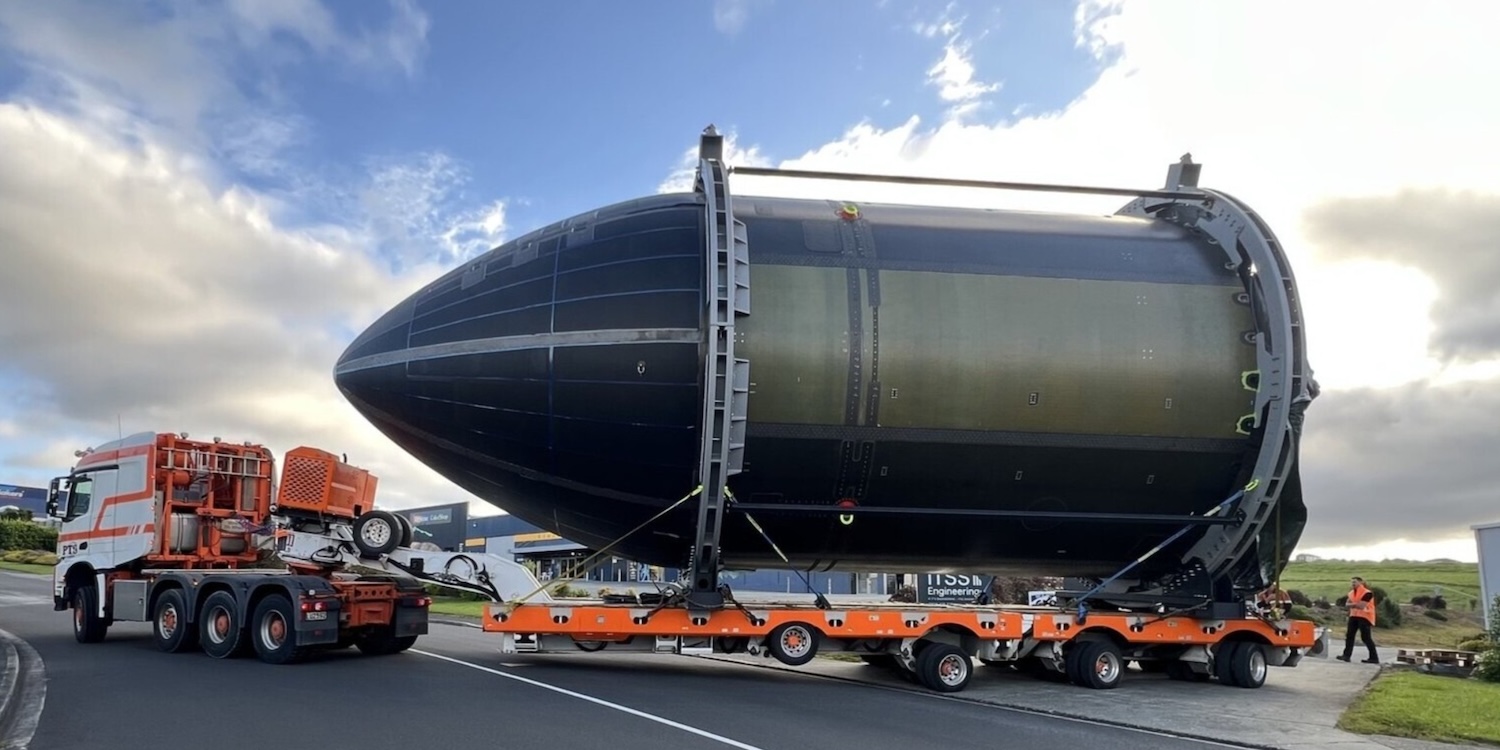
Rocket Lab Corporation (Nasdaq: RKLB) (“Rocket Lab” or “the Company”), a global leader in launch services and space systems, today announced the Neutron launch vehicle’s innovative “Hungry Hippo” captive fairing has successfully completed qualification testing and is enroute to Virginia for Neutron’s first launch.
Dubbed the Hungry Hippo, Neutron’s fairing halves remain attached to the rocket’s first stage throughout launch and landing back to Earth – a world-first for a reusable commercial rocket. Whereas typical rockets’ fairing halves fall away during launch and are disposable or require collection at sea for reuse, Neutron’s fairing halves open to release the rocket’s second stage and mission payload before closing again to return Neutron to Earth as a single reusable vehicle, enabling rapid and cost-effective reuse and streamlining operations for a high-cadence launch service for commercial, civil, and national security missions.
The qualification is a key moment in the development of the reusable Neutron rocket, the world’s largest carbon composite launch vehicle with a lift capacity of up to 13,000kg (33,000 pounds). With the design, structure, and operations of Neutron’s innovative fairing now qualified for flight, Hungry Hippo is enroute to Rocket Lab’s Launch Complex 3 at the Mid-Atlantic Regional Spaceport in Virginia ahead of Neutron’s first launch. Development of Neutron began in late 2021 and with the first launch scheduled for liftoff in 2026, it remains on track to be one of the fastest commercially developed rockets in history.
Rocket Lab Vice President – Neutron, Shaun D’Mello, says: “A rocket like Neutron has never been built before, and we’re doing it at a pace and price point that’s going to bring the innovation and competition needed in today’s industry. Building, qualifying, and shipping Hungry Hippo is a fantastic marker of progress toward Neutron’s first launch, and I’m proud of the team for their attention to detail and pulling off this significant milestone.”
Hungry Hippo Qualification Program
To qualify the Hungry Hippo fairing for Neutron’s first launch, Rocket Lab completed an intensive qualification and acceptance testing campaign that validated the structure’s expected performance during the intense aerodynamic pressure of launch and re-entry featuring full-scale tests as well as a series of sub-component tests. Tests have included (but are not limited to):- 275,000 pounds of force distributed across the Hungry Hippo’s carbon composite structure to simulate the load experienced during Max Q, the stage of flight where the rocket experiences maximum aerodynamic pressure.
- Opening and closing the fairing halves under flight-like conditions in 1.5 seconds, less than half the time required for a successful stage separation and vehicle reorientation for descent.
- Flight-like operations combining flight software, avionics, GNC systems, and more, controlling both the canard actuation and fairing actuation systems, and using flight hardware for all avionics, harnessing, and mechanical systems.
- Combined torque and bending loads introduced at the canard hubs where the vehicle’s aerodynamic control surfaces, or canards, are integrated to Neutron’s fairing structure. These tests exceeded 125% of the load expected through all phases of flight.
- Exceedance of the handling loads that Hungry Hippo will experience throughout Neutron’s full lifecycle: from integration of the Stage 2 that is attached to the interior of the rocket through to the full assembly Neutron and integration of the launch vehicle onto the launch mount, as well as recovery of the launch vehicle from its landing barge named ‘Return On Investment’.
Once Hungry Hippo arrives in Virginia, the fairing structure will be integrated to Neutron’s first stage in final flight configuration to undergo pre-launch testing, including static fires and a Wet Dress Rehearsal, at Launch Complex 3 ahead of first launch.
About Rocket Lab
Rocket Lab is a leading space company that provides launch services, spacecraft, payloads and satellite components serving commercial, government, and national security markets. Rocket Lab’s Electron rocket is the world’s most frequently launched orbital small rocket; its HASTE rocket provides hypersonic test launch capability for the U.S. government and allied nations; and its Neutron launch vehicle in development will unlock medium launch for constellation deployment, national security and exploration missions. Rocket Lab’s spacecraft and satellite components have enabled more than 1,700 missions spanning commercial, defense and national security missions including GPS, constellations, and exploration missions to the Moon, Mars, and Venus. Rocket Lab is a publicly listed company on the Nasdaq stock exchange (RKLB).
About Neutron
Rocket Lab’s Neutron launch vehicle is a powerful new solution designed to deliver a cost-effective, reliable, and responsive launch service for commercial and government missions and to help solve bottlenecked launch across the global space industry. Designed for reusability, responsive launch, and orbital insertion accuracy for up to 13,000 kg of payload, Neutron will set a new standard for performance and reliability for the highest-priority defense and national security missions, commercial satellite constellations, and civil space exploration. Neutron utilizes a unique design that brings the Stage 1 and payload fairing back to Earth as a single, integrated stage that maximizes cadence in a 13-ton to orbit reusable performance capability. The advanced design of Neutron includes carbon composite for all of the rocket’s major structures and an innovative upper stage that enables high-performance for complex satellite deployments, including the deployment of satellite mega-constellations. Neutron is powered by nine Archimedes engines on Stage 1, and one vacuum-optimized Archimedes engine on Stage 2. Neutron operates from Rocket Lab Launch Complex 3 (LC-3) located at Wallops Island, Virginia from the Mid-Atlantic Regional Spaceport (MARS).
Source: Rocket Lab
