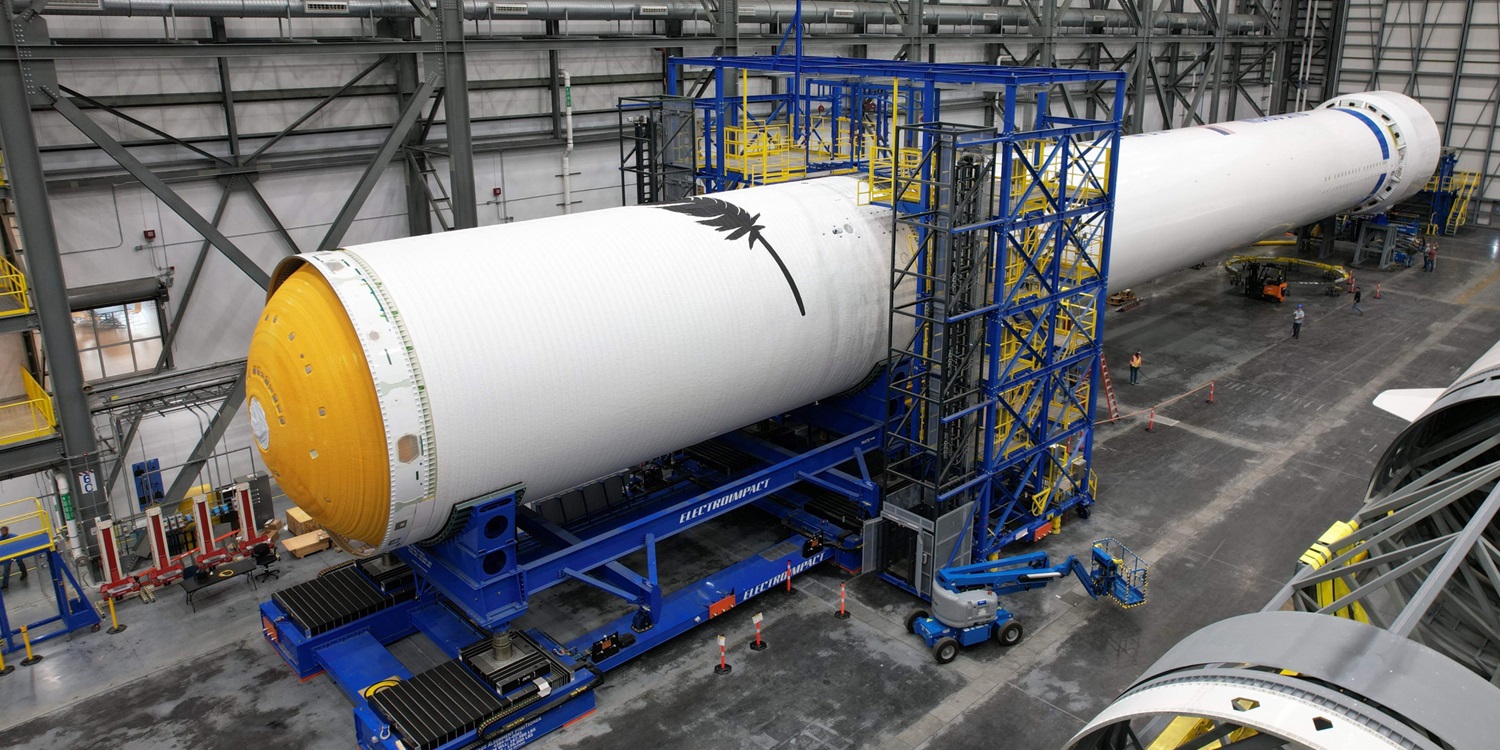
Blue Origin announced a series of upgrades to New Glenn designed to increase payload performance and launch cadence, while enhancing reliability. The enhancements span propulsion, structures, avionics, reusability, and recovery operations, and will be phased into upcoming New Glenn missions beginning with NG-3.

One of the primary enhancements includes higher-performing engines on both stages. Total thrust for the seven BE-4 booster engines is increasing from 3.9 million lbf (17,219 kN) to 4.5 million lbf (19,928 kN). BE-4 has already demonstrated 625,000 lbf on the test stand at current propellant conditions and will achieve 640,000 lbf later this year, with propellant subcooling increasing the current thrust capability from the existing 550,000 lbf.

The total thrust of the two BE-3Us powering New Glenn’s upper stage is increasing from the original design of 320,000 lbf (1,423 kN) to 400,000 lbf (1,779 kN) thrust over the next few missions. BE-3U has already demonstrated 211,658 lbf on the test stand.

These enhancements will immediately benefit customers already manifested on New Glenn to fly to destinations including low-Earth orbit, the Moon, and beyond. Additional vehicle upgrades include a reusable fairing to support increased flight rates, an updated lower-cost tank design, and a higher-performing and reusable thermal protection system to improve turnaround time.

The next chapter in New Glenn’s roadmap is a new super-heavy class rocket. Named after the number of engines on each stage, New Glenn 9x4, is designed for a subset of missions requiring additional capacity and performance. The vehicle carries over 70 metric tons to low-Earth orbit, over 14 metric tons direct to geosynchronous orbit, and over 20 metric tons to trans-lunar injection. Additionally, the 9x4 vehicle will feature a larger 8.7-meter fairing.

Both vehicles: 9x4 and our current variant, 7x2, will serve the market concurrently, giving customers more launch options for their missions, including mega-constellations, lunar and deep space exploration, and national security imperatives such as Golden Dome.

Source: Blue Origin

Share on Social Media

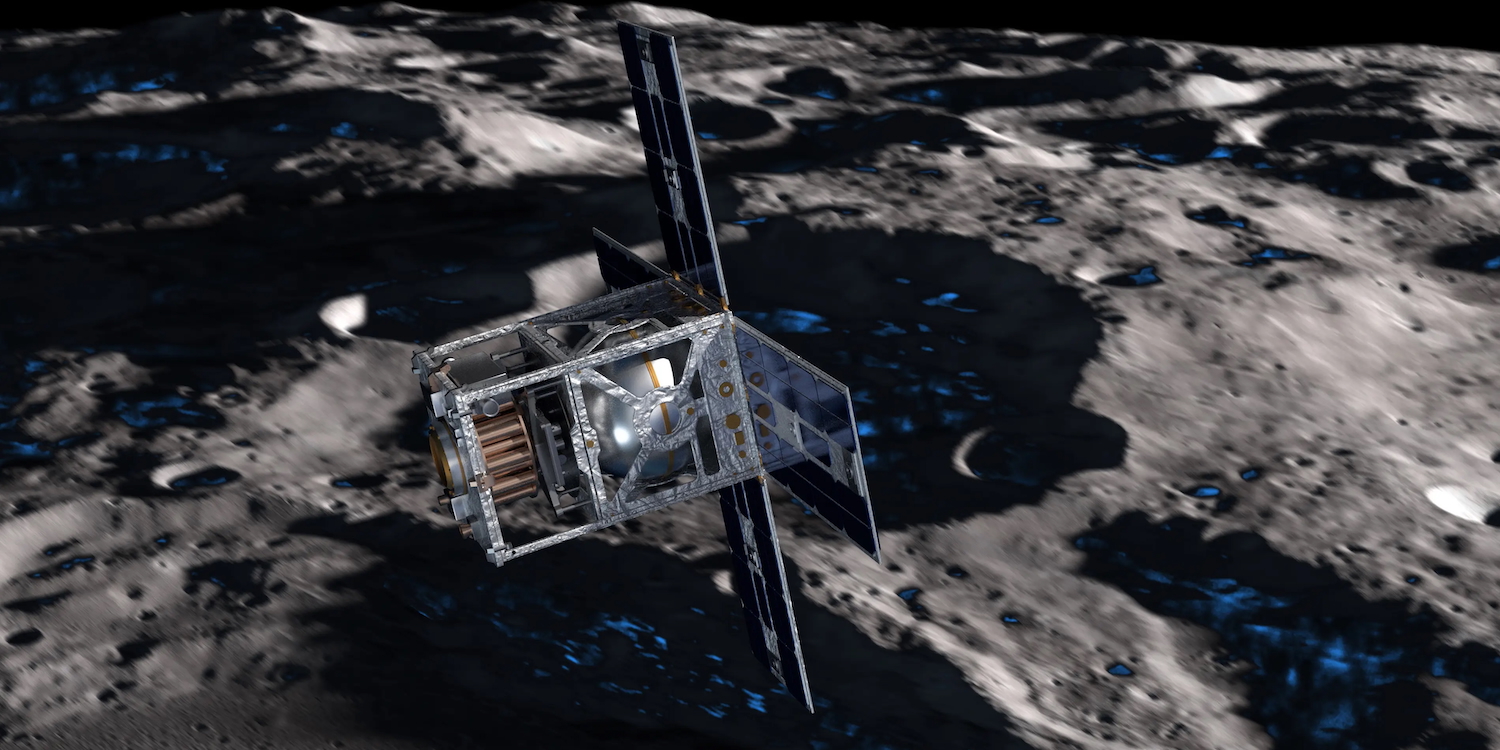
Blue Origin today announced Project Oasis, a multi-phase initiative to identify key lunar resources from orbit, assess them on the ground, and harness them in situ. Oasis-1, alongside Luxembourg partners, is the first mission in the Oasis campaign. It will create the most detailed high-resolution maps to date of lunar water ice, Helium-3, radionuclides, rare earth elements, precious metals, and other materials crucial for humanity’s expansion into space for the benefit of Earth.

Harnessing the water ice found by Oasis-1 could provide hydrogen and oxygen for spacecraft propellant, positioning the Moon as an off-world refueling station for orbital destinations and deep space missions. Additionally, lunar resources could support local lunar surface power, advanced in-space manufacturing, clean energy systems, and reduced reliance on terrestrial extraction on Earth. "Once we know what's really there and how to access it, everything changes," said Pat Remias, vice president, Advanced Concepts and Enterprise Engineering. "Project Oasis creates the foundation for a thriving space economy that benefits everyone, including the billions of individuals on Earth who will benefit from space-based resources."

Project Oasis makes the construction of space infrastructure economically viable and strategically sustainable by integrating low-cost space transportation with in-situ resource utilization. While Oasis-1 will carry out resource prospecting, it will be further enabled through Blue Alchemist, which will process regolith into useful products like oxygen, solar cells, and power cables. Together, these efforts seek to transform the Moon into a resource and power hub, lowering costs and complexity for missions to Mars and beyond, making asteroid harnessing viable in the future, and enabling greater sustainability on Earth.

In partnership with Luxembourg and its national space agency, Project Oasis is being developed jointly by Blue Origin's Space Resources Center of Excellence (SRCE), the world's largest dedicated facility for space resources prospecting and utilization, and the company’s international office in Luxembourg. GOMSpace and ESRIC in Luxembourg are also supporting the project.

Project Oasis addresses a fundamental challenge in space development: the prohibitive cost of transporting materials from Earth. By producing propellant and construction materials from lunar resources, the program aims to reduce deep-space mission costs by up to 90% through in-space refueling, enable permanent lunar settlements with locally sourced building materials, establish strategic resource security for national space capabilities, and provide a platform for international collaboration to unlock the vast potential of space resources.

Project Oasis employs neutron spectroscopy to quantify subsurface water ice concentrations to one-meter depths, the most reliable method for resource assessments. The ultra-low orbital altitude enables unprecedented spatial resolution impossible with traditional high-altitude orbiters. Additional instruments include magnetometers for metal detection and multispectral imaging for Helium-3 and geological mapping, with controlled impact sequences maximizing data collection for precise extraction site selection.

Source: Blue Origin

Share on Social Media

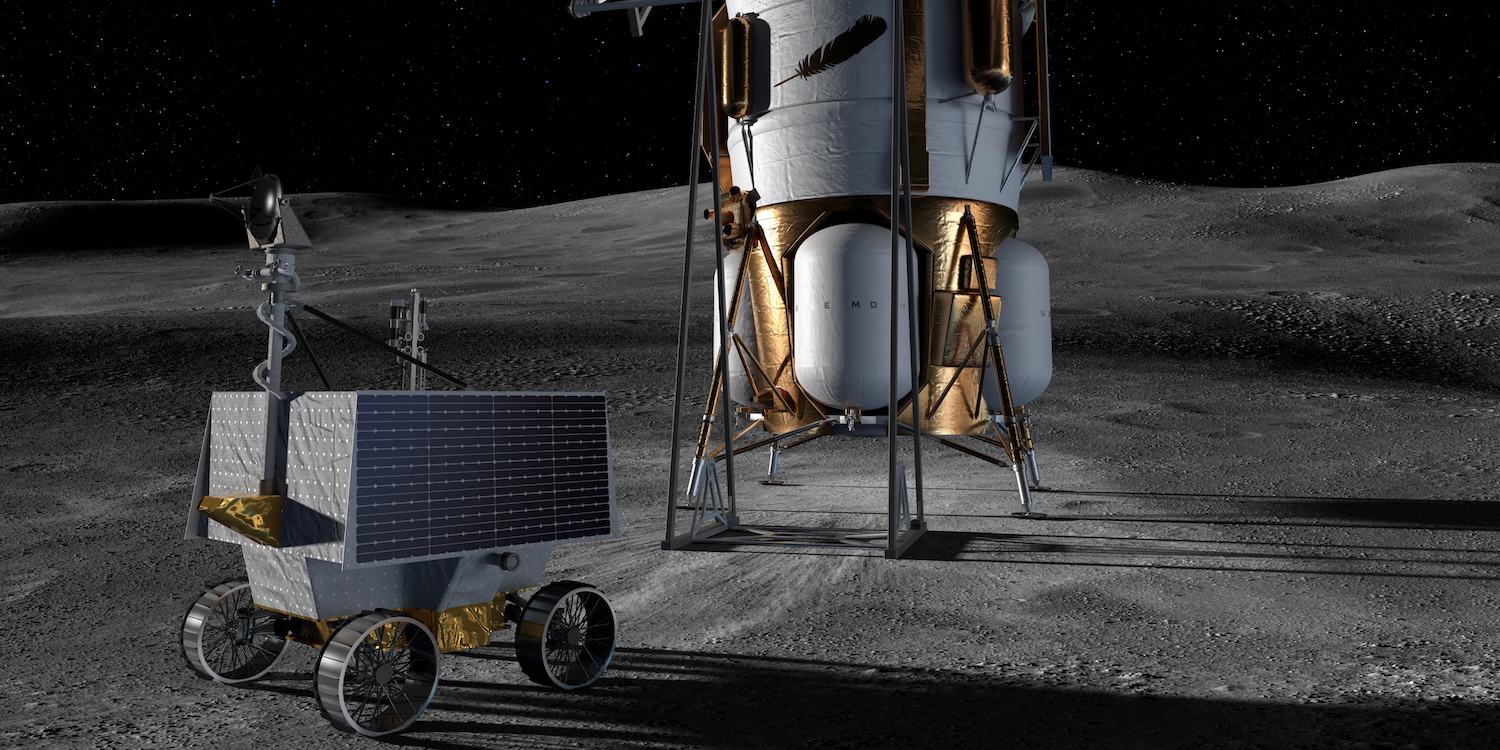
As part of the agency’s Artemis campaign, NASA has awarded Blue Origin of Kent, Washington, a CLPS (Commercial Lunar Payload Services) task order with an option to deliver a rover to the Moon’s South Pole region. NASA’s VIPER (Volatiles Investigating Polar Exploration Rover) will search for volatile resources, such as ice, on the lunar surface and collect science data to support future exploration at the Moon and Mars.

“NASA is leading the world in exploring more of the Moon than ever before, and this delivery is just one of many ways we’re leveraging U.S. industry to support a long-term American presence on the lunar surface,” said acting NASA Administrator Sean Duffy. “Our rover will explore the extreme environment of the lunar South Pole, traveling to small, permanently shadowed regions to help inform future landing sites for our astronauts and better understand the Moon’s environment – important insights for sustaining humans over longer missions, as America leads our future in space.”

The CLPS task order has a total potential value of $190 million. This is the second CLPS lunar delivery awarded to Blue Origin. Their first delivery – using their Blue Moon Mark 1 (MK1) robotic lander – is targeted for launch later this year to deliver NASA’s Stereo Cameras for Lunar-Plume Surface Studies and Laser Retroreflective Array payloads to the Moon’s South Pole region.

With this new award, Blue Origin will deliver VIPER to the lunar surface in late 2027, using a second Blue Moon MK1 lander, which is in production. NASA previously canceled the VIPER project and has since explored alternative approaches to achieve the agency’s goals of mapping potential off-planet resources, like water.

“NASA is committed to studying and exploring the Moon, including learning more about water on the lunar surface, to help determine how we can harness local resources for future human exploration,” said Nicky Fox, associate administrator, Science Mission Directorate, NASA Headquarters in Washington. “We’ve been looking for creative, cost-effective approaches to accomplish these exploration goals. This private sector-developed landing capability enables this delivery and focuses our investments accordingly – supporting American leadership in space and ensuring our long-term exploration is robust and affordable.”

The task order, called CS-7, has an award base to design the payload-specific accommodations and to demonstrate how Blue Origin’s flight design will off-load the rover to the lunar surface. There is an option on the contract to deliver and safely deploy the rover to the Moon’s surface. NASA will make the decision to exercise that option after the execution and review of the base task and of Blue Origin’s first flight of the Blue Moon MK1 lander. This unique approach will reduce the agency’s cost and technical risk. The rover has a targeted science window for its 100-day mission that requires a landing by late 2027.

Blue Origin is responsible for the complete landing mission architecture and will conduct design, analysis, and testing of a large lunar lander capable of safely delivering the lunar volatiles science rover to the Moon. Blue Origin also will handle end-to-end payload integration, planning and support, and post-landing payload deployment activities. NASA will conduct rover operations and science planning.

“The search for lunar volatiles plays a key role in NASA’s exploration of the Moon, with important implications for both science and human missions under Artemis,” said Joel Kearns, deputy associate administrator for exploration, Science Mission Directorate, NASA Headquarters. “This delivery could show us where ice is most likely to be found and easiest to access, as a future resource for humans. And by studying these sources of lunar water, we also gain valuable insight into the distribution and origin of volatiles across the solar system, helping us better understand the processes that have shaped our space environment and how our inner solar system has evolved.”

Through CLPS, American companies continue to demonstrate leadership in commercial space advancing capabilities and accomplishing NASA’s goal for a commercial lunar economy. NASA’s Ames Research Center in California’s Silicon Valley led the VIPER rover development and will lead its science investigations, and NASA’s Johnson Space Center in Houston provided rover engineering development for Ames.

Source: NASA

Share on Social Media

Blue Origin’s next New Shepard flight, NS-29, will simulate the Moon’s gravity and fly 30 payloads, all but one of which is focused on testing lunar-related technologies. The launch window opens on Tuesday, January 28, at 10:00 AM CST / 1600 UTC from Launch Site One in West Texas. The webcast will begin 15 minutes before liftoff.

The payloads will experience at least two minutes of lunar gravity forces, a first for New Shepard and made possible in part through support from NASA. The flight will test six broad lunar technology areas: In-situ resource utilization, dust mitigation, advanced habitation systems, sensors and instrumentation, small spacecraft technologies, and entry descent and landing. Proving out these technologies at lower cost is another step toward Blue Origin’s mission to lower the cost of access to space for the benefit of Earth. It also enables NASA and other lunar surface technology providers to test innovations critical to achieving Artemis program goals and exploring the Moon’s surface.

The New Shepard crew capsule is using its Reaction Control System (RCS) to spin up to approximately 11 revolutions per minute. This spin rate simulates one-sixth Earth gravity at the midpoint of the crew capsule lockers. In simulated lunar gravity, customers can accelerate their learning and technology readiness for lunar payloads at much lower cost. Previously, the Moon’s gravity could only be simulated a few seconds at a time via centrifuge drop tower or for ~20 seconds aboard parabolic flights.

New Shepard’s 29th flight brings the total number of commercial payloads flown on New Shepard to more than 175. Of the mission's 30 payloads, 29 will fly inside the crew capsule and one will fly on the booster with exposure to the ambient space environment. More than half are supported by NASA’s Flight Opportunities program, which is managed by the agency’s Space Technology Mission Directorate. Four of the payloads are from Honeybee Robotics, a division within Blue Origin’s In-Space Systems business. Honeybee’s experiments will test technologies focused on penetrating, excavating, and processing lunar regolith.

This mission will fly our dedicated payloads capsule paired with our recently-debuted booster, demonstrating the compatibility between the boosters and capsules in our fleet and increasing launch availability for our customers. We now have three capsules and two boosters in service to better address sales demand for payloads and astronauts.

The mission will also carry thousands of postcards on behalf of Club for the Future, Blue Origin’s STEAM-focused nonprofit whose mission is to inspire and mobilize future generations to pursue careers in science, technology, engineering, arts, and math. The organization has engaged more than 44 million people globally since its founding in 2019.

NS-29 Manifest Highlights

Electrostatic Dust Lofting (EDL), NASA Kennedy Space Center: EDL is a project studying how Moon dust gets electrically charged and lifted up when exposed to ultraviolet light. Insights from this study will help future lunar missions address dust problems. The project was created by NASA's Kennedy Space Center in Florida along with the University of Central Florida and the University of Colorado, Boulder.

Fluidic Operations in Reduced Gravity Experiment (FORGE), NASA Jet Propulsion Laboratory (JPL): FORGE will test how to manage liquids and gases in space. This technology is critical for instruments that may monitor water quality for astronauts or search for evidence of life on ocean worlds in our solar system.

Honey Bubble Excitation Experiment (H-BEE), Honeybee Robotics: H-BEE is a tool evaluating how bubbles behave in thick liquids on the Moon. The insights will help better predict how oxygen bubbles will act in melted Moon rock during a process called molten regolith electrolysis.

Soil Properties Assessment Resistance and Thermal Analysis (SPARTA), JPL: SPARTA is a toolkit designed for geomechanical testing below the lunar surface. The test aims to understand how lunar gravity affects its performance. SPARTA was created by JPL in Southern California and developed by Honeybee Robotics.

Lunar-g Combustion Investigation (LUCI), NASA Glenn Research Center: LUCI is an experiment to study how materials catch fire in the Moon's gravity compared to Earth's. The findings will help NASA and its partners create safer living and working habitats for people on the Moon. This project is developed by NASA’s Glenn Research Center in Cleveland, Ohio, together with Voyager Technologies.

Film Evaporation MEMS Tunable Array Micropropulsion System (FEMTA), Purdue University: FEMTA is a water-based micro-propulsion system in development by researchers at Purdue. This small thruster helps precisely control the direction and positioning of small satellites. The experiments are measuring how well FEMTA and its passive propellant delivery system work in the low-gravity environment of space. The experiment will be flown on the New Shepard booster.

Source: Blue Origin
Share on Social Media

New Glenn safely reached its intended orbit during today's NG-1 mission, accomplishing our primary objective. New Glenn’s seven BE-4 engines ignited on January 16, 2025, at 2:03 a.m. EST (0703 UTC) from Launch Complex 36 at Cape Canaveral Space Force Station.

The second stage is in its final orbit following two successful burns of the BE-3U engines. The Blue Ring Pathfinder is receiving data and performing well. We lost the booster during descent. “I’m incredibly proud New Glenn achieved orbit on its first attempt,” said Dave Limp, CEO, Blue Origin. “We knew landing our booster, So You’re Telling Me There’s a Chance, on the first try was an ambitious goal. We’ll learn a lot from today and try again at our next launch this spring. Thank you to all of Team Blue for this incredible milestone.”

New Glenn is foundational to advancing our customers’ critical missions as well as our own. The vehicle underpins our efforts to establish sustained human presence on the Moon, harness in-space resources, provide multi-mission, multi-orbit mobility through Blue Ring, and establish destinations in low Earth orbit. Future New Glenn missions will carry the Blue Moon Mark 1 cargo lander and the Mark 2 crewed lander to the Moon as part of NASA’s Artemis program.

The program has several vehicles in production and multiple years of orders. Customers include NASA, Amazon’s Project Kuiper, AST SpaceMobile, and several telecommunications providers, among others. Blue Origin is certifying New Glenn with the U.S. Space Force for the National Security Space Launch (NSSL) program to meet emerging national security objectives.

"Today marks a new era for Blue Origin and for commercial space," said Jarrett Jones, Senior Vice President, New Glenn. "We're focused on ramping our launch cadence and manufacturing rates. My heartfelt thanks to everyone at Blue Origin for the tremendous amount of work in making today's success possible, and to our customers and the space community for their continuous support. We felt that immensely today."

Source: Blue Origin

Share on Social Media

More Articles …