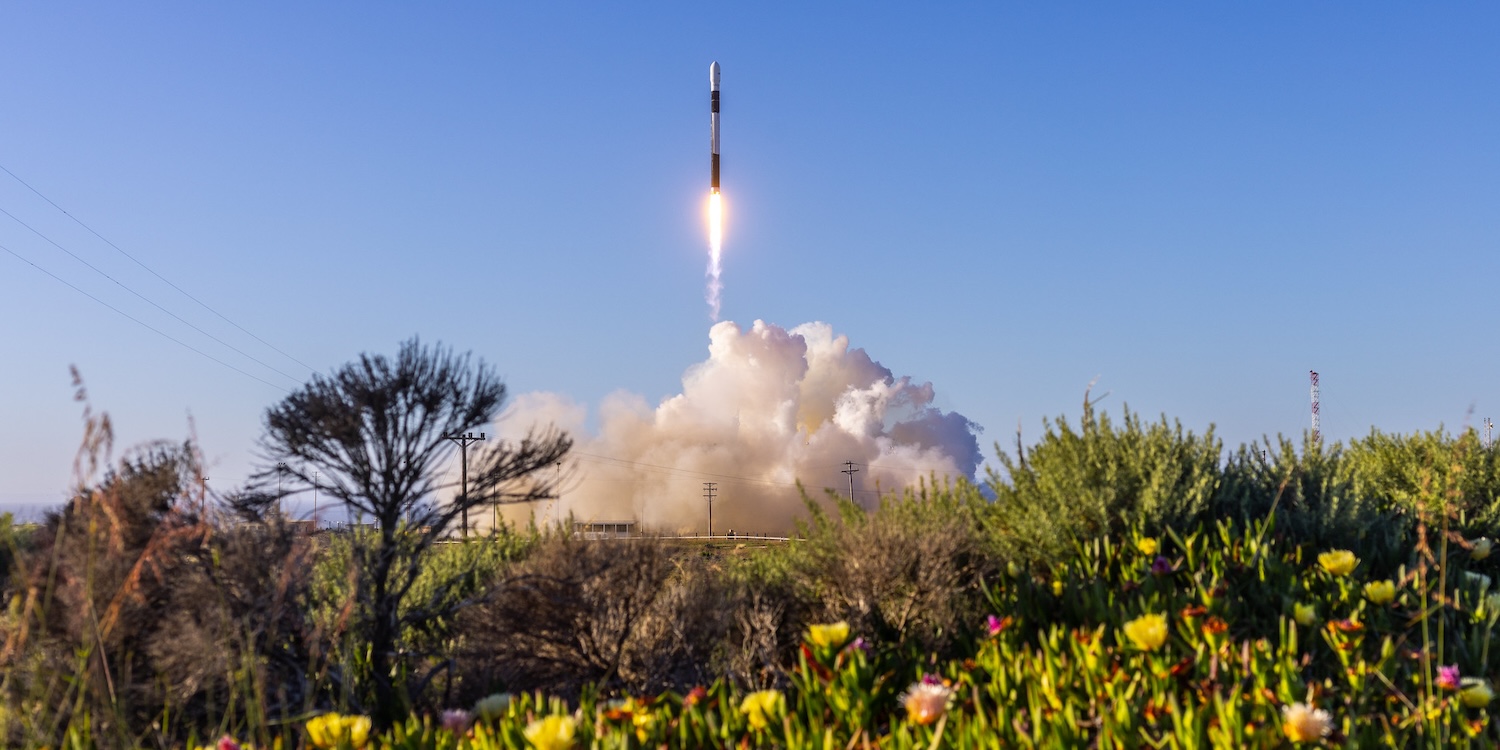
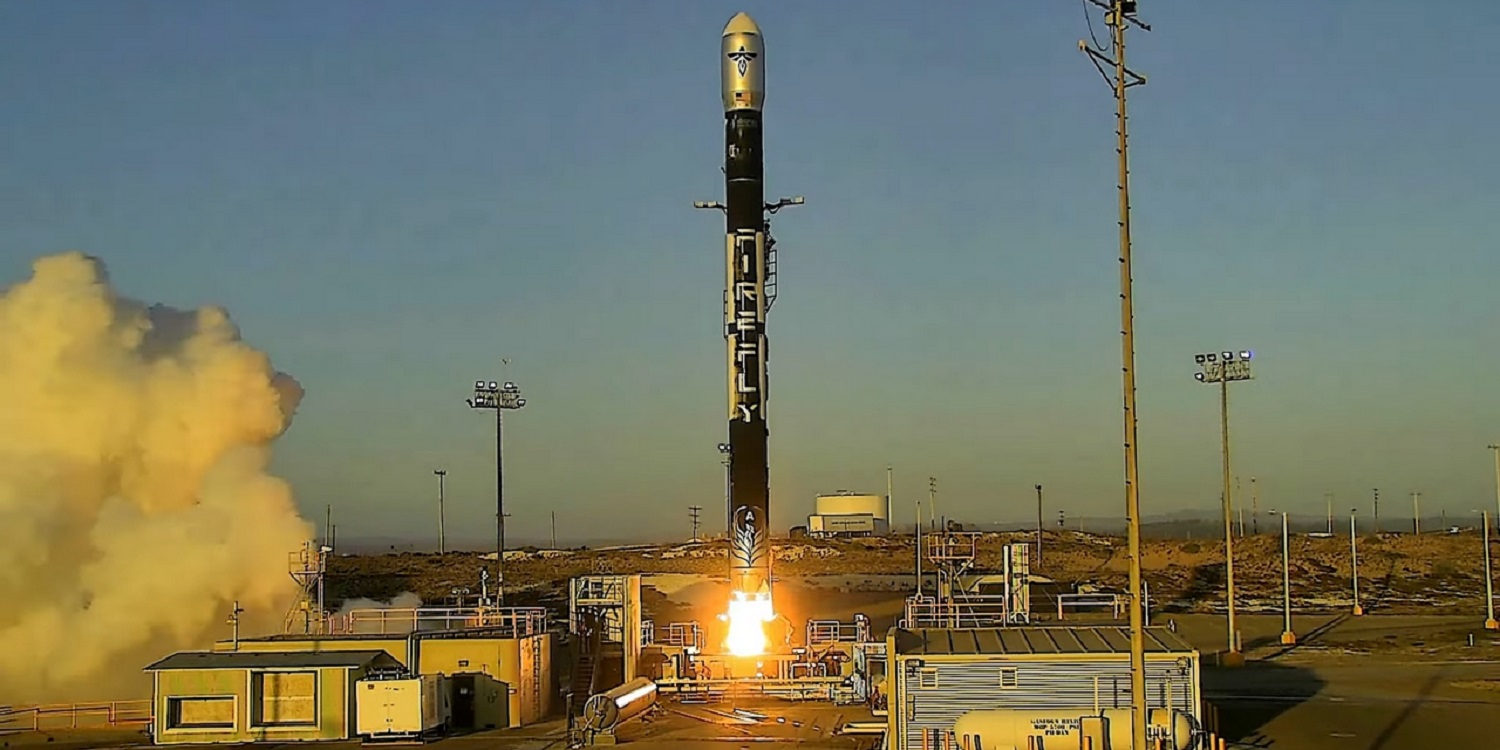
Firefly Aerospace (Nasdaq: FLY), a market leading space and defense technology company, today announced the successful launch of its Alpha Flight 7 Stairway to Seven mission. Alpha lifted off from Firefly’s Space Launch Complex 2 at the Vandenberg Space Force Base at 5:50 pm PDT on March 11 before completing an orbital insertion and delivering a demonstrator payload for Lockheed Martin. Firefly’s Alpha rocket also performed a stage two engine relight and validated key Alpha Block II upgrades, including a new in-house avionics suite and enhanced thermal protection system, ahead of the full Block II configuration upgrade planned for Flight 8.
“Alpha Flight 7 was flawlessly executed with all mission requirements completed, further proving the resiliency, innovation, and passion of the Firefly team,” said Jason Kim, CEO of Firefly Aerospace. “Over the last several months, we took a hard look at our processes across engineering, production, test, integration, and operations and invested the time required to make a series of improvements to ensure a higher level of quality and reliability in every Alpha we deliver and launch as we move to our Block II upgrade.”
The Firefly team is now working to complete the final milestones for Alpha Flight 8 that is set to launch the full Block II configuration upgrade designed to enhance reliability and manufacturability across the vehicle. The upgrades include a 7-foot increase to Alpha’s length, consolidated batteries and avionics built in house, improved thermal protection system, and stronger carbon composite structures built with automated machinery.
“Flight 7 served as a critical opportunity to validate Alpha’s performance ahead of our Block II upgrade, and this team knocked it out of the park,” said Adam Oakes, Vice President of Launch at Firefly Aerospace. “I’m incredibly proud of the Firefly team for continuing to define perseverance. We have full confidence in our Alpha rocket, and we’re committed to continuous improvement as we roll out Block II. We want to thank Space Launch Delta 30 and our customers for their ongoing collaboration and support.”
About Firefly Aerospace
Firefly Aerospace is a space and defense technology company that enables government and commercial customers to launch, land, and operate in space – anywhere, anytime. As the partner of choice for responsive space missions, Firefly is the only commercial company to launch a satellite to orbit with approximately 24-hour notice. Firefly is also the only company to achieve a fully successful landing on the Moon. Established in 2017, Firefly’s engineering, manufacturing, and test facilities are co-located in central Texas to enable rapid innovation. The company’s small- to medium-lift launch vehicles, lunar landers, and orbital vehicles are built with common flight-proven technologies to enable speed, reliability, and cost efficiencies for each mission from low Earth orbit to the Moon and beyond.
Cedar Park, Texas, May 29, 2025 – Northrop Grumman Corporation (NYSE: NOC) has invested $50 million into Firefly Aerospace to further advance production of their co-developed medium launch vehicle, now known as Eclipse™. The companies continue to make progress in the development of Eclipse flight hardware with qualification testing underway and more than 60 Miranda engine hot fire tests performed to date.
“Firefly is incredibly grateful for Northrop Grumman’s investment that further solidifies our first-of-its-kind partnership to build the first stage of Antares 330 and jointly develop Eclipse,” said Jason Kim, CEO of Firefly Aerospace. “Eclipse represents two powerful forces coming together to transform the launch market with decades of flight heritage, a rapid, iterative approach, and bold innovation. With a 16 metric ton to orbit capability, Eclipse is a sweet spot for programs like NSSL Lane 1 and a natural fit to launch proliferated constellations in LEO, MEO, GEO, and TLI.”
Built upon Northrop Grumman’s Antares and Firefly’s Alpha rocket, Eclipse offers a significant leap in power, performance, production cadence, and payload capacity. The launch vehicle retains the flight-proven avionics from the Antares program with additional upgrades, including a larger 5.4 meter payload fairing. Eclipse also utilizes the same first stage Firefly is developing for Antares 330 and retains scaled-up versions of Alpha’s propulsion systems and carbon composite structures, allowing the team to rapidly build and test Eclipse with significant production efficiencies and economies of scale.
Firefly utilized the same patented tap-off cycle architecture from Alpha’s Reaver and Lightning engines for Eclipse’s Miranda and Vira engines, and completed mission duty cycle with a 206 second Miranda hot fire, matching the longest time the engine will burn during a flight. Following several development test campaigns, flight hardware has been manufactured for the common dome propellant tanks, engine bay and interstage.
“Eclipse gives customers the right balance between payload capacity and affordability,” said Wendy Williams, vice president and general manager, launch and missile defense systems, Northrop Grumman. “Our partnership with Firefly builds on our capacity to provide crucial spaced-based communication, observation, and exploration for civil and national security customers.”
Filling a void in an underserved market, Eclipse is equipped to deliver 16,300 kg of cargo to low Earth orbit or 3,200 kg of cargo to geosynchronous transfer orbit. Eclipse will first launch from Wallops Island, Virginia, as early as 2026 and is able to support space station resupply, commercial spacecraft, critical national security missions and scientific payloads for the domestic and international markets.
About Firefly Aerospace
Firefly Aerospace is an end-to-end responsive space company with launch, lunar, and on-orbit services. Headquartered in central Texas, Firefly is a portfolio company of AE Industrial Partners (“AEI”) focused on delivering rapid, reliable, and affordable space access for government and commercial customers. Firefly’s small- to medium-lift launch vehicles, lunar landers, and orbital vehicles provide the space industry with a single source for missions from low Earth orbit to the surface of the Moon and beyond.
About Northrop Grumman
Northrop Grumman is a leading global aerospace and defense technology company. Our pioneering solutions equip our customers with the capabilities they need to connect and protect the world, and push the boundaries of human exploration across the universe. Driven by a shared purpose to solve our customers’ toughest problems, our employees define possible every day.
On April 29, 2025 Firefly’s Alpha FLTA006 launch began with a nominal liftoff and progressed through first stage flight, reaching target separation velocity. The rocket then experienced a mishap between stage separation and second stage ignition that led to the loss of the Lightning engine nozzle extension, substantially reducing the engine’s thrust.
Initial indications showed Alpha’s upper stage reached 320 km in altitude. However, upon further assessment, the team learned the upper stage did not reach orbital velocity, and the stage and payload have now safely impacted the Pacific Ocean in a cleared zone north of Antarctica.
Firefly recognizes the hard work that went into payload development and would like to thank our mission partners at Lockheed Martin for their continued support. The team is working closely with our customers and the FAA to conduct an investigation and determine root cause of the anomaly. We will provide more information on our mission page after the investigation is completed.
Alpha FLTA006 was the second mission Firefly launched for Lockheed Martin and the first of Firefly’s multi-launch agreement with Lockheed Martin that includes up to 25 missions over the next five years. The mission carried Lockheed Martin’s LM 400 tech demo with a goal to prove out the risk-reduction and pathfinding efforts the company has done for its multi-mission satellite bus.
About the payload
Lockheed Martin’s LM 400 Technology Demonstrator is the latest in a series of self-funded missions by the company to demonstrate the maturity of new technology on orbit and reduce risk for their customers. The LM 400 tech demo was specifically built to showcase the company’s pathfinding efforts for its LM 400 mid-sized, multi-mission satellite bus, and to demonstrate the space vehicle’s operational capabilities on orbit for potential customers. As a platform, Lockheed Martin’s LM 400 is the company’s most flexible satellite bus, capable of serving military, commercial or civil customers. It can be customized to host a variety of missions, including remote sensing, communications, imaging and radar – and operate in any orbit.
Cedar Park, Texas, March 3, 2025 – Firefly Aerospace, the leader in end-to-end responsive space services, today announced the company was awarded a fixed-price NASA’s Venture-Class Acquisition of Dedicated and Rideshare (VADR) contract for a dedicated Alpha launch of the agency’s Investigation of Convective Updrafts (INCUS) mission from NASA’s Wallops Flight Facility in Virginia. As part of NASA’s Earth System Science Pathfinder program, INCUS is a NASA Earth Venture-Mission with three satellites that will study why, when, and where tropical storms form to help advance climate change models.
“Firefly offers our customers responsive operations and mission flexibility with launch sites on the East and West Coast of the United States and internationally,” said Jason Kim, CEO of Firefly aerospace. “We strategically built our one metric ton Alpha rocket to support dedicated missions like INCUS. This allows our customers to place their satellites in the exact orbit they need and use their mission-critical resources to immediately begin conducting research and making advancements in science.”
Once deployed, three INCUS satellites will fly in tight coordination to study the behavior of tropical storms and thunderstorms, including how storm systems form, evolve, and dissipate. According to NASA, each satellite will have a high frequency precipitation radar that observes rapid changes in convective cloud depth and intensities. One of the three satellites also will carry a microwave radiometer to provide the spatial content of the larger scale weather observed by the radars. By flying so closely together, the satellites will use the slight differences in when they make observations to apply a novel time-differencing approach to estimate the vertical transport of convective mass.
The INCUS mission will launch from the Mid-Atlantic Regional Spaceport Pad 0A at NASA’s Wallops Flight Facility that supports both Alpha and Firefly’s Medium Launch Vehicle. INCUS will be Firefly’s third Alpha launch for NASA – the first launched successfully last summer and the second is scheduled from Vandenberg Space Force Base for NASA QuickSounder in 2026.
Firefly’s Alpha rocket is the only commercially operational launch vehicle dedicated to serving the one-metric ton satellite market. The flight-proven vehicle provides responsive, reliable, and cost-competitive launch services directly to customers’ preferred orbits.
About Firefly Aerospace
Firefly Aerospace is an end-to-end space transportation company with launch, lunar, and on-orbit services. Headquartered in central Texas, Firefly is a portfolio company of AE Industrial Partners (“AEI”) focused on delivering responsive, reliable, and affordable space access for government and commercial customers. Firefly’s small- to medium-lift launch vehicles, lunar landers, and orbital vehicles provide the space industry with a single source for missions from low Earth orbit to the surface of the Moon and beyond.
Firefly Aerospace, the leader in end-to-end responsive space services, today announced Firefly’s Blue Ghost lunar lander launched on a SpaceX Falcon 9 rocket, successfully acquired signal, and completed on-orbit commissioning. With a target landing date of March 2, 2025, Firefly’s 60-day mission is now underway, including approximately 45 days on-orbit and 14 days of lunar surface operations with 10 instruments as part of NASA’s Commercial Lunar Payload Services (CLPS) initiative.
Blue Ghost Mission 1, named Ghost Riders in the Sky, launched from Launch Complex 39A at NASA’s Kennedy Space Center in Florida, at 1:11 a.m. EST on January 15, 2025. Blue Ghost separated from the SpaceX Falcon 9 rocket in a highly elliptical Earth orbit at 2:17 a.m. EST and established communications with Firefly’s Mission Operations Center in Cedar Park, Texas, at 2:26 a.m. EST. On-orbit spacecraft commissioning was then completed by 5:30 a.m. EST, which included verifying attitude determination and control capabilities, increasing the data transfer rate, establishing a power-positive attitude, and completing initial lander health checks.
“On behalf of Firefly, we want to thank SpaceX for a spot-on deployment in our target orbit,” said Jason Kim, CEO of Firefly Aerospace. “The mission is now in the hands of the unstoppable Firefly team. After all the testing conducted and mission simulations completed, we’re now fully focused on execution as we look to complete our on-orbit operations, softly touch down on the lunar surface, and pave the way for humanity’s return to the Moon.”
Firefly’s Blue Ghost will spend approximately 25 days in Earth orbit, four days in lunar transit, and 16 days in lunar orbit, enabling the team to conduct robust health checks on each subsystem, calibrate the propulsion system in preparation for critical maneuvers, and begin payload science operations. The NASA payloads operating during the Earth-to-Moon transit include LuGRE, which will monitor GPS signals to help extend Global Navigation Satellite System capabilities to the lunar surface, and RadPC, which will begin demonstrating the computer’s ability to withstand space radiation while on-orbit.
Upon landing in Mare Crisium, Blue Ghost will operate 10 NASA payloads for a complete lunar day (about 14 Earth days) and support several science and technology demonstrations, including lunar subsurface drilling, sample collection, X-ray imaging, and dust mitigation. Just before lunar night, Blue Ghost will capture high-definition imagery of a total eclipse from the Moon where the Earth blocks the sun. Blue Ghost will then capture the lunar sunset, providing data on how lunar regolith reacts to solar influences during lunar dusk conditions, before operating several hours into the lunar night.
“Towards the end of Blue Ghost Mission 1, we expect to capture a phenomenon documented by Eugene Cernan on Apollo 17 where he observed a horizon glow as the lunar dust levitated on the surface,” said Kim. “As a tribute to the last Apollo Astronaut to walk on the Moon, we’re honored to have the opportunity to watch this incredible sight in high definition." The Ghost Riders in the Sky mission is one of four task orders Firefly has been awarded by NASA CLPS as part of NASA’s Artemis campaign that is working to establish a long-term presence on the Moon and prepare for Mars exploration.
January 15, 2025: Successful launch
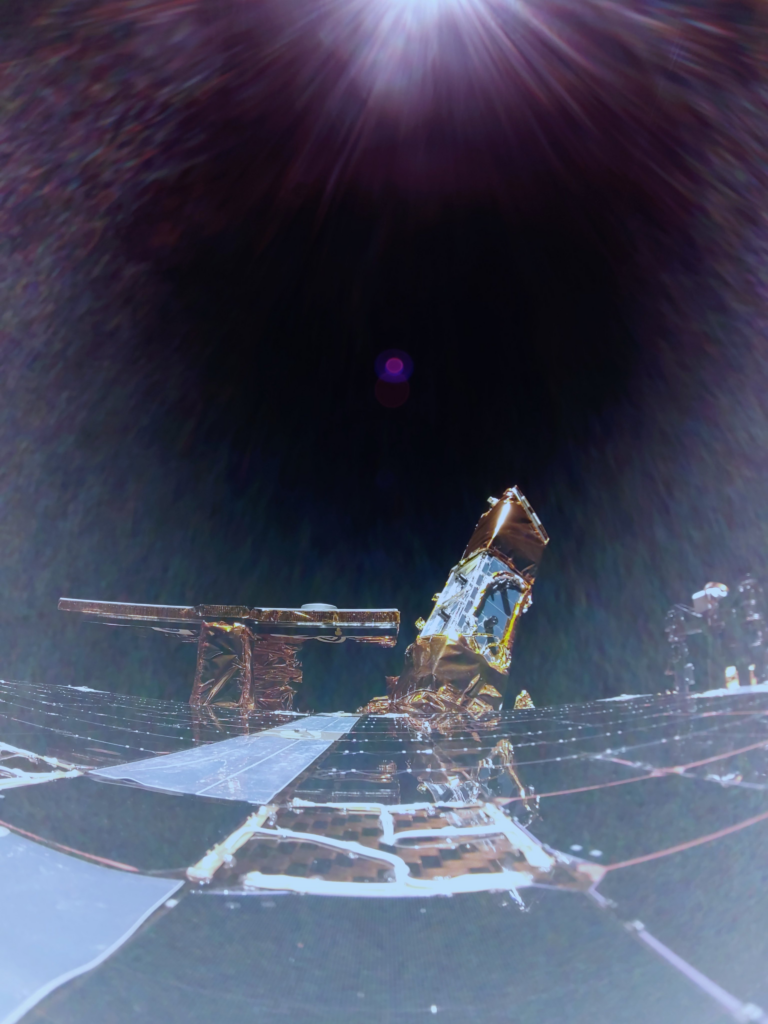
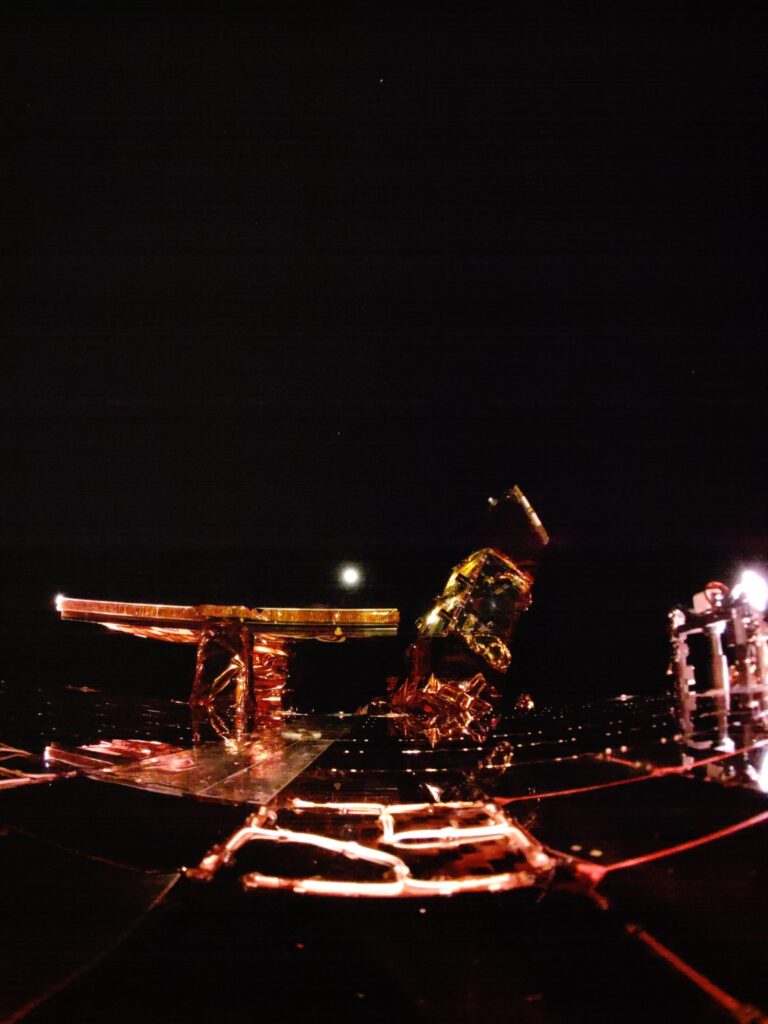
January 15, 2025: First On-Orbit Image
Firefly’s Blue Ghost captured its first image from space! The top deck of the lander is visible with the X-band antenna and NASA’s LEXI payload.
January 15, 2025: On-Orbit Payload Science Begins
The Firefly team completed initial NASA payload checkouts and powered on Montana State University’s RadPC to begin measuring the radiation and fault tolerant computing system. This is the first of many payload data sets Blue Ghost will capture on Firefly’s journey to the Moon.
January 16, 2025: LuGRE Science Operations
All NASA payloads remain healthy. Six NASA payloads onboard Blue Ghost, including RadPC, SCALPSS, LPV, LISTER, LuGRE, and EDS are already sending initial data back to Earth. LuGRE science operations have also begun. Developed by the Italian Space Agency, LuGRE is tracking signals from GPS and Galileo satellites during our Earth to Moon transit to test signal acquisition and usage along the way.
January 18, 2025: First Engine Burn
Big win for the Ghost Riders! The Firefly team successfully completed Blue Ghost’s first burn with our RCS thrusters and main engine, hitting within 2 mm/s of our target delta V on the first try. This burn increased the lander’s perigee (the closest point to Earth) and gets us ready for our next critical maneuver. Take a look at these engines firing with invisible plumes in the vacuum of space.
January 24, 2025: Second Engine Burn
Firefly captured the beauty of our home planet during another Earth orbit burn. This second engine burn (and first critical burn) adjusted Blue Ghost’s apogee (the furthest point from Earth) using our Spectre RCS thrusters. With just over two weeks left in Earth orbit before our Trans Lunar Injection, the Firefly team will continue operating our NASA payloads onboard and capturing science data along the way.
January 27, 2025: First Moon Image
While in Earth orbit, Firefly’s Blue Ghost lunar lander captured our first images of the Moon.
January 28, 2025: LEXI Payload Calibration
The Firefly team began calibrating the LEXI X-ray imager to maximize its performance levels and prepare for operations on the lunar surface. Developed by Boston University, NASA, and John Hopkins, LEXI will be calibrated daily until we land on the Moon. The payload will then capture a series of X-ray images to study the interaction of solar wind and the Earth’s magnetic field that drives geomagnetic disturbances and storms on our home planet.
January 30, 2025: Week 2 Mission Operations Update
Two weeks into Firefly’s mission, and Blue Ghost has already clocked 715,000 miles and downlinked more than 7 GB of data. In our week two recap, the Firefly mission operations team provides an overview of our orbital mechanics and thermal dynamics and explains why Blue Ghost is taking a scenic route to the Moon.
February 20, 2025: Week 5 Mission Operations Update
10 days left in Firefly’s lunar roadtrip and Blue Ghost has traveled 2.2 million miles so far and downlinked 18.7 GB of data! The Firefly team has already accomplished so many milestones, but there are still more to come. Catch our week 5 update on what’s next as we prepare to land on the Moon on March 2.
February 21, 2025: LuGRE and LEXI Payload Science Operations
All 10 NASA payloads remain healthy as Blue Ghost approaches its final destination and continues to support science operations along the way. The LuGRE payload for example – developed in partnership by the Italian Space Agency and NASA Goddard Space Flight Center, acquired and tracked Global Navigation Satellite System signals for the first time in lunar orbit – a new record! The LEXI telescope, developed NASA, Boston University, and Johns Hopkins University, has also operated for several hours every day, conducting checkouts and initial commissioning in preparation for collecting images from the lunar surface.
February 24, 2025: Third Lunar Orbit Maneuver Complete
Blue Ghost’s third and final lunar orbit maneuver is complete! Early this morning, the Firefly team performed a 16-second burn with our RCS thrusters to enter a near-circular low lunar orbit. Up next, we’ll perform a 19-second Descent Orbit Insertion at our 100-km perilune to begin our descent to Blue Ghost’s final destination, Mare Crisium, on March 2.
February 26, 2025: Moon Footage in Low Lunar Orbit
Firefly’s Blue Ghost lander captured more incredible footage of the Moon during its third lunar orbit maneuver on February 24 that inserted the spacecraft in a near-circular low lunar orbit. The video below, sped up by 10X, was taken about 100 km above the lunar surface, showing the far side of the Moon and a top-down view of Blue Ghost’s RCS thrusters (center) and radiator panels on each side. The radiator panels are moving nominally to protect Blue Ghost’s subsystems from extreme temperatures.